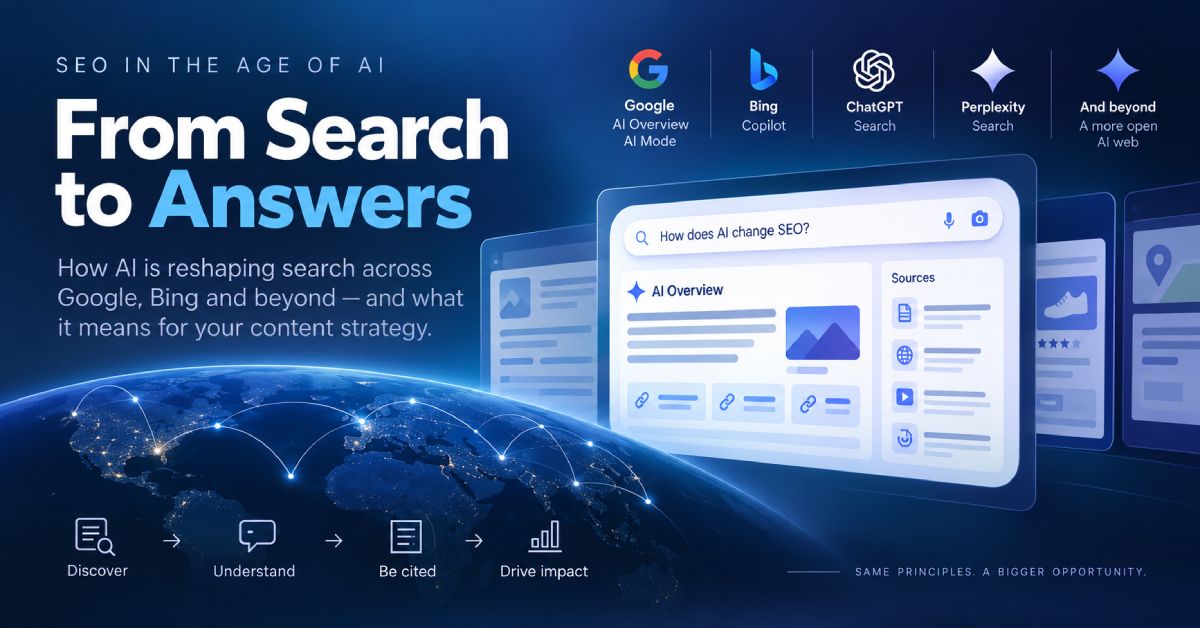
Online search is undergoing one of its most significant transformations since the birth of search engines.
For many years, the model was relatively simple:
Query ⇨ Search results page ⇨ Click ⇨ Website
Today, this journey can no longer be taken for granted.
Google, Bing, and emerging AI-powered search platforms are increasingly able to understand complex questions, perform multiple searches, compare sources, and generate answers directly for users.
Google has introduced and progressively expanded AI Overviews and AI Mode. Microsoft is integrating search with Bing and Copilot, while systems such as ChatGPT Search are further transforming the concept of a search engine by combining web search with AI-generated answers.
The result is a significant shift in user behaviour: for many informational queries, users no longer need to visit multiple websites to build an answer themselves.
Search engines are therefore evolving from lists of documents into systems for retrieving, understanding, and synthesising information.
This does not mean that SEO is dead.
It means that its purpose is expanding.
We should no longer ask only:
“How can I rank this page?”
but also:
“How can I make this page a reliable source that a search engine or AI system can find, understand, retrieve, and cite?”
From SEO to AEO and GEO
In recent years, terms such as SEO, AEO, and GEO have become increasingly common.
SEO: Search Engine Optimization
Optimising websites and content to gain visibility in traditional search engines.
AEO: Answer Engine Optimization
Optimising content so that it can directly contribute to the answer provided to the user.
GEO: Generative Engine Optimization
Optimising a website’s presence within AI-powered and generative search experiences.
However, these should not be considered three completely separate disciplines.
SEO remains the foundation.
Google has clarified that AI Overviews and AI Mode continue to rely on its core Search ranking and quality systems and that no special technical requirements are needed to appear in generative search features.
Microsoft is also increasingly using the term GEO to describe how content participates in AI experiences and is selected as a source for generated answers.
We can therefore represent this evolution as:
SEO ⇨ Discovery
AEO ⇨ Answer
GEO ⇨ Citation & Generative Visibility
SEO enables content to be discovered.
AEO and GEO extend this concept towards making content easier to understand, retrieve, and use within generative answers.
Types of Queries and the Risk of Traffic Loss
The impact of generative search is not the same for every type of query.
Informational Queries: HIGH RISK
These are queries where the user is primarily looking for an explanation.
For example:
- What is the OAuth2 protocol?
- What does canonical URL mean?
- How does a CDN work?
- What is the difference between SEO and SEM?
For these queries, a generative answer can often provide a sufficiently complete explanation immediately.
The consequence is an increase in zero-click searches: searches that end without the user visiting an external website.
Comparative and Research Queries: MEDIUM/HIGH RISK
AI platforms are particularly effective at comparisons.
A question such as:
“Which CMS is better suited to an international healthcare portal: Drupal or WordPress?”
may require the system to compare:
- security;
- scalability;
- multi-country management;
- editorial workflows;
- SSO;
- privacy;
- integrations;
- costs;
- maintenance.
Google AI Mode and other generative systems can perform multiple searches to build this comparison directly.
Clicks remain important when users want to verify a source, explore a technical aspect in greater depth, read about real-world experience, or analyse more detailed data.
Transactional Queries: LOWER RISK
When users need to complete an action, websites continue to play a fundamental role.
For example:
- purchasing a product;
- booking a hotel;
- requesting a quote;
- signing up for a service;
- downloading software;
- contacting a company.
However, this area is evolving as well.
AI Agents are progressively transforming artificial intelligence from a system that simply provides answers into a technology capable of interacting with services and applications.
The evolution could therefore be represented as:
Search ⇨ Answer ⇨ Conversation ⇨ Action
How Generative Search Works
Not every search engine uses the same architecture, and we do not know every detail of how their systems work.
However, we can identify a general model.
1. Understanding Intent
The system interprets the request and attempts to understand:
- meaning;
- context;
- entities;
- intent;
- relationships between concepts.
As a result, an exact match between the keyword entered by the user and the text on a page is becoming less important.
2. Query Fan-Out
One of the most interesting features of generative search is query fan-out.
Google has officially confirmed that AI Overviews and AI Mode can perform multiple related searches across different subtopics and data sources.
A complex query can therefore be broken down into several secondary searches.
For example:
“What is the best CMS platform for a European HCP portal?”
could generate searches related to:
healthcare CMS
Drupal security
WordPress healthcare
GDPR CMS
multi-country CMS
HCP authentication
SSO healthcare portal
Content therefore does not necessarily need to match the exact wording of the user’s original query to become a relevant source.
Retrieval, Grounding, and RAG
One of the fundamental concepts behind AI-powered search is grounding.
A Large Language Model contains knowledge acquired during training, but when answering questions that require current information, it can use external sources.
One approach used for this is Retrieval-Augmented Generation (RAG).
In simplified terms:
Query
⇩
Retrieval
⇩
Source Selection
⇩
Information Extraction
⇩
Answer Generation
⇩
Citations / Links
Google explicitly confirms the use of RAG and grounding techniques within its generative search features.
Microsoft also considers grounding a central component of the AI-powered web: web sources allow generative systems to connect their answers to up-to-date and verifiable information.
For SEO and content professionals, this means something important:
before content can be used in an AI-generated answer, it needs to be discoverable, understandable, and considered sufficiently relevant.
This is precisely where traditional SEO continues to play a fundamental role.
Google, Bing, and the New Search Landscape
This transformation is not limited to Google.
Google primarily operates through:
- traditional Search;
- AI Overviews;
- AI Mode.
AI Overviews synthesise information directly within the SERP when Google determines that doing so adds value to the search experience.
AI Mode extends this model further by enabling more complex searches, comparisons, and conversational follow-up questions.
Both can use query fan-out to discover sources that may differ from those surfaced by a single traditional search query.
Bing and Microsoft Copilot
Microsoft is following a similar direction through Bing and Copilot.
One particularly interesting development is the introduction of AI Performance in Bing Webmaster Tools.
The report allows publishers to analyse metrics such as:
- total citations;
- cited pages;
- grounding queries;
- citation trends over time.
Microsoft is therefore beginning to distinguish more explicitly between traditional SEO visibility and visibility within AI-generated answers.
This may provide an early indication of how SEO analytics tools will evolve over the coming years.
ChatGPT Search and Emerging AI Search Engines
Alongside traditional search engines, we are seeing the growth of systems where search is integrated directly into an AI assistant.
ChatGPT Search, for example, can search the web and use external pages as sources for its answers.
For publishers, this introduces another dimension of organic visibility.
There is no longer only:
Google ranking
but rather an ecosystem consisting of:
Search visibility
AI visibility
Citation visibility
Brand visibility
A website can therefore generate value even when its content is used as a source without necessarily generating an immediate click.
From Keywords to Topics, Intent, Entities, and Context
Keywords are not disappearing.
Their strategic role, however, is changing.
The traditional approach:
One keyword ⇨ One page
is becoming less effective when applied too rigidly.
A modern approach should instead consider:
Keyword ⇨ Topic ⇨ Intent ⇨ Entity ⇨ Context
Google has also clarified that there is no need to create dozens of pages simply to cover every possible long-tail variation.
Modern search systems can understand synonyms, concepts, and entities even when there is no literal match with the user’s query.
Building comprehensive semantic coverage of a topic is therefore becoming increasingly important.
How to Write Content for AI-Powered Search
There is no magic formula for getting cited.
Nor is there an ideal paragraph length that guarantees inclusion in an AI-generated answer.
The objective should be to make content easy to understand for both people and information retrieval systems.
A good structure can include:
- descriptive headings;
- clear paragraphs;
- direct answers when appropriate;
- tables for comparing data;
- lists when they improve readability;
- precise definitions;
- examples;
- verifiable sources;
- connections between related concepts.
The old idea of an Atomic Answer that must always be 40-60 words long should therefore not be considered an SEO rule.
The answer simply needs to be clear, complete, and proportionate to the question.
The Real Competitive Advantage: Non-Commodity Content
Artificial intelligence makes it extremely easy to produce generic content.
And that is precisely why generic content is losing value.
Google uses the concept of non-commodity content to describe content that adds something beyond information that is already widely available.
This may include:
- first-hand experience;
- tests;
- benchmarks;
- proprietary data;
- original research;
- case studies;
- screenshots;
- real-world examples;
- well-supported expert opinions;
- internally developed methodologies.
An article that simply repeats:
“10 benefits of cloud computing”
can easily be summarised by an AI system.
An article presenting:
“How we reduced response times by 38% by migrating this architecture to Azure”
contains information that the model is unlikely to find elsewhere.
This distinction will become increasingly important.
E-E-A-T in AI-Powered Search
Experience, Expertise, Authoritativeness, and Trustworthiness continue to represent important concepts for assessing content quality.
However, they should not be interpreted as a single “AI ranking factor”.
The fundamental principle remains demonstrating that the content is supported by genuine experience, expertise, and verifiable information.
Experience
Demonstrate real-world experience through:
- tests;
- real cases;
- screenshots;
- original photos;
- problems encountered;
- results achieved.
Expertise
Demonstrate expertise through:
- technical insights;
- appropriate terminology;
- sources;
- data;
- accurate explanations;
- clear author profiles.
Authoritativeness
Build authority through:
- citations;
- backlinks;
- mentions;
- publications;
- industry reputation.
Trustworthiness
Strengthen trust through:
- verifiable sources;
- identifiable authors;
- editorial transparency;
- publication and update dates;
- clear company information;
- website security.
Structured Data: Important, but Without the Myths
Schema.org and structured data remain important SEO tools.
They help search engines understand certain types of information and may enable specific rich results.
However, they should not be considered a requirement for being used in AI-generated answers.
Google has clarified that there is no special Schema.org markup for AI Overviews or AI Mode.
Structured data should therefore be implemented when it accurately represents the content on the page and provides genuine value to Search.
For example:
- Article;
- Product;
- Organization;
- Person;
- Event;
- BreadcrumbList;
- LocalBusiness.
The principle remains simple:
Use structured markup when it adds meaning; do not create artificial markup simply to “convince the AI”.
Images, Video, and Multimodal Content
Search is becoming increasingly multimodal.
Answers can include:
- text;
- images;
- video;
- products;
- maps;
- structured information;
- interactive elements.
Google explicitly recommends complementing textual content with high-quality images and videos where appropriate.
It is therefore important to consider:
- image quality;
- alt text;
- file names;
- surrounding text;
- captions;
- video SEO;
- image/video sitemaps where appropriate;
- consistency between visual and textual content.
An original diagram or technical screenshot can provide significantly greater informational value than a generic stock image.
Topic Clusters and Internal Linking
Generative search further reinforces the importance of topical authority.
A single isolated article is unlikely to demonstrate the same depth as a connected content ecosystem.
An effective structure might look like this:
Pillar Page
Deep Dive A
Deep Dive B
Case Study
FAQ
Tutorial
Comparison
Internal linking helps search engines understand:
- relationships between content;
- hierarchy;
- context;
- topical depth.
It also improves crawling and content discovery.
Technical SEO: What Does Not Change
Artificial intelligence does not eliminate the need for a technically solid website.
The fundamentals remain essential:
- crawlability;
- indexability;
- robots.txt;
- XML sitemaps;
- canonical tags;
- correct redirects;
- HTTP status codes;
- performance;
- mobile usability;
- accessibility;
- JavaScript rendering;
- internal linking;
- understandable HTML;
- important content available in textual form.
If a search engine cannot properly retrieve content, it is unlikely to be able to use that content as a source.
The New SEO KPIs
One of the biggest mistakes will be continuing to measure success exclusively through organic traffic.
Traditional KPIs remain important:
- rankings;
- impressions;
- CTR;
- clicks;
- organic sessions;
- conversions.
However, they increasingly need to be complemented by new metrics:
- citations in AI-generated answers;
- cited pages;
- branded searches;
- brand mentions;
- direct traffic;
- referrals from AI platforms;
- engagement;
- conversion rate;
- visibility for strategically relevant queries.
Bing has already started this transition through AI Performance in Bing Webmaster Tools, providing data on citations and grounding queries from Copilot, Bing AI, and selected partner experiences.
Google, on the other hand, currently includes AI Overviews and AI Mode within the overall Web search traffic reported in Search Console.
Measuring AI visibility is therefore still a rapidly evolving area.
SEO Is Not Disappearing: Its Objective Is Changing
For years, the primary SEO objective was:
Achieve a ranking
⇩
Generate a click
⇩
Bring the user to the website
Today, the journey can increasingly become:
Be discovered
⇩
Be considered relevant
⇩
Be retrieved as a source
⇩
Be cited
⇩
Build trust
⇩
Generate a visit or an action
This fundamentally changes how we should assess the value of content.
Content can contribute to brand visibility even before a click occurs.
Conclusion
SEO is not dead.
On the contrary, it remains part of the infrastructure on which much of the new AI-powered search ecosystem is being built.
What is changing is the context.
We are no longer optimising solely for a results page made up of ten blue links.
We are optimising for an ecosystem where several different experiences coexist:
Search Engine
Answer Engine
Generative Engine
AI Assistant
AI Agent
Google AI Overviews, AI Mode, Bing, Microsoft Copilot, and emerging AI platforms are progressively transforming how information is discovered and used.
The future of SEO is therefore not about finding tricks to “please LLMs”.
It is about building technically accessible websites and creating content that has something genuinely valuable to offer:
experience, data, expertise, clarity, authority, and original information.
In the past, the main objective was to get the click.
Today, the objective is also to become a source for the answer.
Tomorrow, it may be about becoming both a source and a service that AI agents can interact with directly.
Primary Sources:
Google Search Central – AI features and your website,Google – Generative AI optimization guide,Bing Webmaster – AI Performance