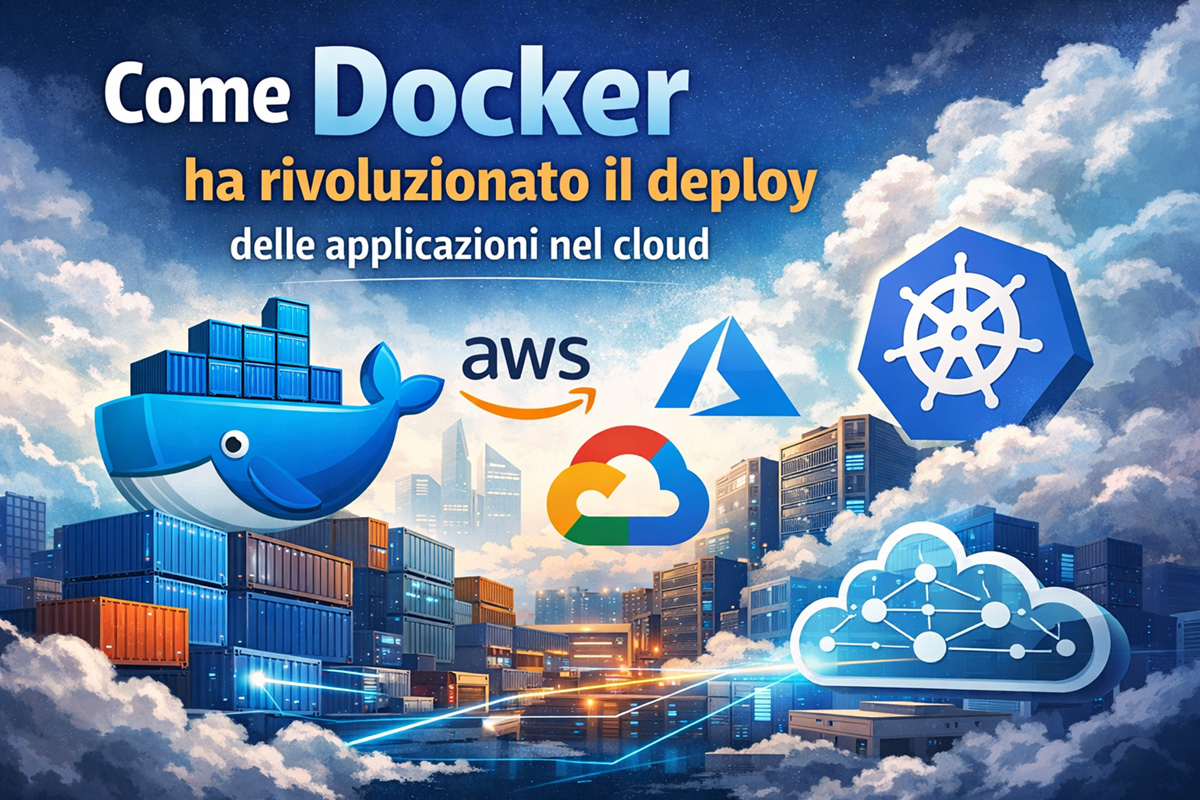
Docker and Modern Deployment: A Revolution in the Cloud World
In recent years, Docker has become a de facto standard in software development and application deployment. Thanks to containerization, Docker has made release processes faster, more reliable, and reproducible, revolutionizing how development and DevOps teams operate in the cloud.
But what makes Docker so important? And why do all major cloud providers support it natively?
What Docker Is and Why It Changed Deployment
Docker is a platform that allows you to “package” an application together with all its dependencies into a lightweight and portable container. Unlike traditional virtual machines, containers share the operating system kernel, making them faster, more efficient, and easier to manage.
This innovation solved one of the historical problems of software deployment:
“Works on my machine, but not in production.”
With Docker, development, testing, and production environments become consistent and predictable.
Major Cloud Providers Supporting Docker
One of the reasons behind Docker’s success is native support from major cloud providers, which integrated it into their infrastructure and orchestration services.
Amazon Web Services (AWS)
AWS supports Docker through services such as:
- Amazon ECS (Elastic Container Service)
- Amazon EKS (Elastic Kubernetes Service)
- Integration with EC2 and Fargate
AWS is often chosen for highly scalable and complex environments.
Microsoft Azure
Azure provides strong Docker integration through:
- Azure Container Instances (ACI)
- Azure Kubernetes Service (AKS)
- Deep integration with Microsoft DevOps tools
It is particularly appreciated in enterprise environments.
Google Cloud Platform (GCP)
Google, the creator of Kubernetes, provides:
- Google Kubernetes Engine (GKE)
- Native container support built into the platform foundations
GCP is considered one of the most mature cloud platforms for containerized workloads.
Docker’s Main Strengths
Docker’s widespread adoption comes from several key advantages:
- Portability: containers run the same way in any environment
- Fast deployment: applications start in seconds
- Resource efficiency: less overhead compared to virtual machines
- Scalability: ideal for microservices architectures
- DevOps integration: perfect for modern CI/CD pipelines
These strengths make Docker a fundamental tool in cloud-native development.
Docker and Kubernetes: From Execution to Orchestration
As the number of containers in production increased, the need for container orchestration tools emerged. This is where Kubernetes comes in.
Kubernetes does not replace Docker; it complements it by handling:
- Container management and replication
- Load balancing
- Auto-scaling
- Application self-healing
In practice, Docker manages how a container runs, while Kubernetes manages how hundreds or thousands of containers operate reliably.
Conclusion
Docker marked a turning point in how application deployment is conceived, making it simpler, faster, and standardized. Support from major cloud providers such as AWS, Azure, and Google Cloud has established containerization as a core pillar of modern cloud computing.
With the evolution toward Kubernetes and container orchestration, Docker continues to be a central technology for anyone looking to build scalable, resilient, and future-ready applications.